Friday, June 7, 2019

Naqia also like Adad-guppi, Nabonidus’ mother


Mystery Of Queen Semiramis: Famous And Powerful Ancient Ruler And Warrior Queen


Naqia of Assyria and Semiramis


Part Two:

Naqia also like Adad-guppi, Nabonidus’ mother


by

 Damien F. Mackey


“In addition to telling us a little of Semiramis, Herodotus narrates a story of a

Babylonian queen called Nitocris. While some have identified this legendary figure with Zakutu (Naqia), the wife of Sennacherib and mother of Esarhaddon,

others have proposed Adad-guppi, the mother of Nabonidus”.
 

Cambridge Ancient History


That Queen Naqia of Assyria, mother of Esarhaddon (c. 681-669 BC, conventional dating), invites strong comparisons with the legendary Queen Semiramis, has been noted by scholars. And I have discussed some of these perceived likenesses in Part One:

https://www.academia.edu/37775839/Naqia_of_Assyria_and_Semiramis

drawing upon examples to be found in, for instance, Dr. Stephanie Dalley’s tremendous book, The Mystery of the Hanging Garden of Babylon (2013).

For example, Dr. Dalley writes:


Here, then, we have a group of material that indicates attachment of Naqia’s deeds to the name ‘Semiramis’. As second wife of Sennacherib, she bears comparison with the historical Sammu-ramat for having her name on inscriptions written during her lifetime, and for supporting publicly first her husband and then her own son, both as kings.

There was every reason, therefore, to conflate the two great queens, two great builders, Naqia would be the wife of the later Assyrian king to whom Diodorus referred when he wrote: ‘the Hanging Garden, as it is called, which was built, not by Semiramis, but by a later Syrian [a Greek reference to Assyrian: Dalley] king …’ His account that ‘Semiramis alongside a Ninus founded ‘Babylon’ on the Euphrates gives details that are applicable to Nineveh: two palaces, technical details of water supply, walls adorned with hunting scenes. ….

[End of quote]


It becomes apparent from Dr. Dalley’s book that some Assyrian advancements and technology were wrongly attributed later (by e.g. the Greco-Romans) to Babylonia - Sennacherib of Assyria commonly being confused by them with Nebuchednezzar.

That is understandable to some extent if I am correct in my proposed collapsing of late neo-Assyria into early neo-Babylonia, and actually identifying Sennacherib of Assyria’s successor, Esarhaddon, with Nebuchednezzar. See e.g. my article:


Esarhaddon a tolerable fit for King Nebuchednezzar


https://www.academia.edu/38017900/Esarhaddon_a_tolerable_fit_for_King_Nebuchednezzar


The Cambridge Ancient History (Vol. III, pt. 1, 1982, pp. 243-244) tells, in regard to Nitocris, of scholars being unable to determine if she were meant to represent Naqia or Adad-guppi:


Related to this discussion is the matter of legends about Assyrian and Babylonian individuals which has been preserved in other languages and literatures, in particular the tales told of Semiramis, Nitocris, and Ahiqar. Legends about Semiramis are found in Greece, Armenia, and Persia but the best-known version is that of Ctesias, as preserved in Diodorus. Since the early days of Assyriology it has been widely accepted that the heroine of the tale should be identified with the historical Sammuramat, wife of Shamshi-Adad V and mother of Adad-nirari III …. In addition to telling us a little of Semiramis, Herodotus narrates a story of a Babylonian queen called Nitocris. While some have identified this legendary figure with Zakutu (Naqia), the wife of Sennacherib and mother of Esarhaddon, others have proposed Adad-guppi, the mother of Nabonidus.

[End of quote]


Similarly, Matt Waters in Ctesias’ “Persica” in Its Near Eastern Context (p. 46) ‘ties up’ altogether Semiramis, Naqia and Adad-guppi:


Semiramis’ legends as preserved in Greek traditions have been traced through prominent Assyrian and Babylonian women such as Naqia (also called “Zakutu”), the wife of Sennacherib (r. 705-681) and mother of Esarhaddon (r. 681-669), as well as Nabonidus’ mother, Adad-guppi.


Naqia may herself, in fact, have been a Babylonian: “Naqia was probably born in Babylonia, but her family may have originated in the Harran area”:

https://en.wikipedia.org/wiki/Naqi%27a


That queen Naqia and Adad-guppi would be alike comes as no surprise to me, given that I have already identified Naqia’s son, Esarhaddon (= Nebuchednezzar) with Adad-guppi’s son, Nabonidus (= Nebuchednezzar). See e.g. my article:


Aligning Neo-Babylonia with Book of Daniel. Part Two: Merging late neo-Assyrians with Chaldeans

 https://www.academia.edu/38330399/Aligning_Neo-Babylonia_with_Book_of_Daniel._Part_Two_Merging_late_neo-Assyrians_with_Chaldeans


Nor would it be surprising if Naqia’s “family may have originated in the Harran area”, given

Adad-guppi’s close association with Harran – some think she was born there: “Adad-guppi Princess of Assyria. Date, Place, Source. Born : -, b. 649 BC in Harran”: http://www.american-pictures.com/genealogy/persons/per01964.htm

Adad-guppi, was an Assyrian priestess, a devotee of the moon god Sîn in the northern Assyrian city of Harran”: https://en.wikipedia.org/wiki/Addagoppe_of_Harran



Tuesday, June 4, 2019

Was Washukanni also biblical Calneh (Calno)?


Mitanni’s “Washukanni”

city of capital importance


Part Two:

Was Washukanni also biblical Calneh (Calno)?


“It is this author’s suggestion that the Calneh of the Bible is Washshukanni …

capital of the powerful Hurrian kingdom of Mitanni … that rose to power

some time around 1500 BC … according to the secular timeline …”.


Anne Habermehl


In Part One of this series:

https://www.academia.edu/35735015/Mitannis_Washukanni_city_of_capital_importance._Part_One_A_completely_new_perspective I (Damien Mackey) tentatively suggested, following a lead from Emmet Sweeney that, as I wrote, “the first great Mitannian king, Parratarna, may have been Shamsi-Adad I”, then logically (from that premise) proceeded to conclude that the Mitannian capital city, Washukanni, was Shamsi-Adad I’s elusive capital city of Shubat-Enlil (modern Tell Leilan). 


I added further on that: “Some have thought to identify Washukanni with the largely unexcavated Tell el Fakhariya, near Tell Halaf in Syria. But this site does not appear to be impressive enough for a capital city”.


Creationist Anne Habermehl, in a 2011 article: Where in the World Is the Tower of Babel?”, who believes that there are in fact “persistent indications that Washshukanni could have been located at ancient Tell Fakhariya, near Ras al Ain …”, has looked to connect Washukanni with the biblical Calneh, or Calno: https://answersingenesis.org/tower-of-babel/where-in-the-world-is-the-tower-of-babel/


Calneh


Calneh is mentioned twice in the KJV Bible, in Genesis 10:10 and Amos 6:2; in addition, it would appear that Calno of Isaiah 10:9 is the same city as Calneh of the other two verses.16a Also, Ezekiel 27: 23 mentions “Canneh”16b in the same verse as Haran, Eden, Sheba, Asshur and Chilmad (a list of cities whose merchants did business with Tyre). As we shall show, there may be good reason to believe that “Canneh” is the same place as Calneh/Calno; indeed, a survey shows that many scholars believe this (for example, Jones 1856, p. 81; Smith 1948, pp. 102, 105). These slightly differing spellings could well be Semitic language variations coming into play, as discussed earlier.


This city in the Genesis triad has had to struggle for recognition of its very existence. In 1944, Albright published a paper in which he claimed to prove that the Hebrew word “Calneh” should be translated “all of them,” and that there actually was no such city in Shinar at all. According to him, Genesis 10:10 should read, “And the beginning of his kingdom was Babel, and Erech, and Accad, all of them in the land of Shinar.” Many scholars have followed this (see for example, Thompson 1971; and van der Toorn and van der Horst 1990 who lists a number of other scholars and biblical translations in agreement with this thesis). Other scholars have refuted the Albright view on various linguistic grounds (Westermann 1984, p. 517; Yahuda 1946), but this idea lives on (Levin 2002). Interestingly, in Amos 6:2, where the KJV reads “Calneh,” the Brenton and NETS LXX both read “all of you” instead of the city’s name; the LXX translators appear to have made the same mistake as Albright, even though both LXX versions had included the actual city’s name in Genesis 10:10 and Isaiah 10:9. This author suggests that the “thence” in the next sentence of Amos 6:2 (Brenton LXX) and the “from there” (NETS LXX) do not make sense if there is no city name in the preceding sentence for these to relate back to, and the LXX translators should have noticed this.


In any case, the Brenton LXX leaves no doubt about the existence of Calneh with its rendering of Isaiah 10:9 (which is somewhat different than the KJV at this point): “Have I not taken the country above Babylon and Chalanes, where the tower was built? (Italics are the author’s.) And have I not taken Arabia,17 and Damascus, and Samaria?” (The NETS version is similar.) We can reasonably conclude that the “tower” of Isaiah 10:9 is the Tower of Babel, because we know that there was a Calneh very close to Babel from Genesis 10. The identifying clause about the tower was probably inserted to distinguish which city was meant, as there were possibly other cities at that time with similar names, as we shall see.


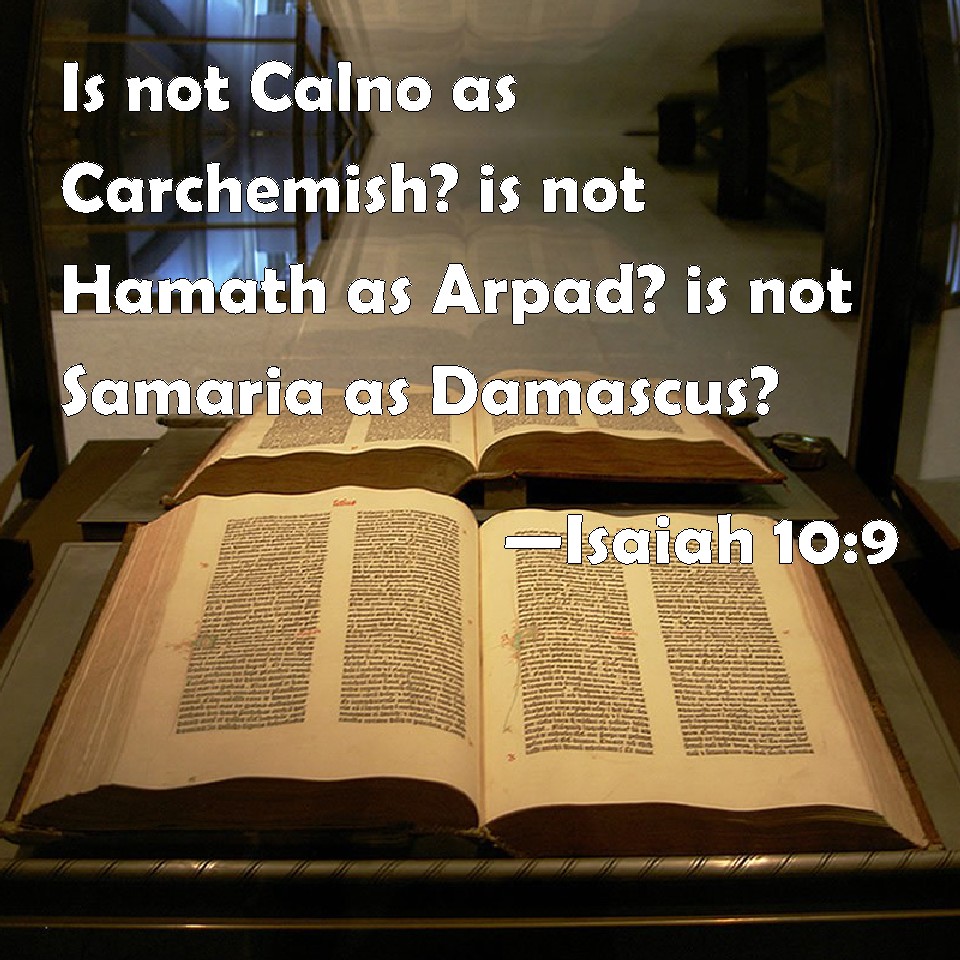
Calneh is also shown to exist in the KJV rendering of Isaiah 10:9: “Is not Calno as Carchemish? Is not Hamath as Arpad? Is not Samaria as Damascus?” Gelb (1935) points out that these three pairs of cities lie in geographical order as the conquerors went westward from their home in Assyria toward western Syria. This puts Calneh in the position of being the first in line of these six cities that the Assyrians had attacked and destroyed, giving us a clue as to its location.


What we know about this Calneh is that it must have been an important city some time before the time of the prophets Isaiah and Amos, because it is mentioned by them at the same time as other important cities—and both prophets mention Calneh first. A reading of the context of both passages, in Amos 6 and Isaiah 10, shows that what the prophets are alluding to is the destruction of all these cities, that had already taken place, and is using them as a warning that the king of Assyria would come and do the same to Israel. At the time of these two prophets, the destruction of these named cities would have been well known. In any case, one might wonder how all the scholars like Albright, who believed that Calneh should disappear in Genesis 10:10 as “all of them,” could ignore the later verses in Isaiah and Amos that only make sense by using the city’s name.


If Calneh was so important, we can reasonably expect that it should appear in ancient history somewhere. Not surprisingly, various biblical writers have been more than willing to supply some ideas on this. For instance, some have equated Calneh with Niffar (ancient Nippur) in South Mesopotamia (Burgess 1857, pp. 374–375; Spiers 1910, pp. 374–375).


Others believed that Calneh (or Canneh) was ancient Ctesiphon, located on the Tigris River opposite Seleucia (Barnes 1855, p. 222; Jones 1856), although a history of the names of this city does not indicate any resembling Canneh (Ctesiphon 2010). It is claimed that a fairly unimportant city with a name similar to Calneh is located near Aleppo in northwest Syria, south of ancient Carchemish. Usually called Zarilab or Zirlaba, scholars tell us that spelling variations of a form of this city’s name could arguably be the same city name as Calneh; these spellings include Kulnia, Kullani, Kullanhu, Kalana, Kulunu, and Kulluna (Gelb 1935; Hastings 2004, p. 185; Pinches 1893, p. 487; Pinches 1908, p. 344). Another Calneh is reported by travelers of the nineteenth century, this one located near the junction of the Khabur and Euphrates rivers (Chesney 1868, p. 250; Vaux 1855, p. 11; Watson and Ainsworth 1894, p. 290). Toffteen (1907, p. 118) believed that Kalneh was Kharsag-kalama, east of Nippur in South Mesopotamia (he considered that the change of “n” to “m” was not uncommon, and offered Shumir = Shinar as an example of this). Clearly, there has not been a shortage of ideas where Calneh could have been located, and we can see why the prophet Isaiah might have wanted to distinguish “where the tower was built.”


It is this author’s suggestion that the Calneh of the Bible is Washshukanni (there are many spelling variations), capital of the powerful Hurrian kingdom of Mitanni (also called Hanigalbat), that rose to power some time around 1500 BC (Oates 1979, p. 207), according to the secular timeline (although the offered dates vary somewhat). Mitanni controlled a large area of north Syria and Assyria at its peak (Oppenheim 1964, pp. 399–400). The city of Washshukanni is generally believed to be somewhere in the Khabur triangle area, but most sources claim that this city has never been found. However, there are persistent indications that Washshukanni could have been located at ancient Tell Fakhariya, near Ras al Ain, west of Amuda/Urakka (see figs. 3 and 4). Moore (1978, pp. 183–184) concludes that Tell Fakhariyah goes back to earliest times (seventh millennium BC in the secular timeline). A city named Sikan(i) is believed to be Tell Fakhariya because of a statue with a bilingual inscription that was found there (Greenfield and Shaffer 2001, p. 217; Huehnergard 1986; Millard 2000, p. 115). There has been discussion among scholars as to whether the Assyrian “Sikani” could be a derivative of the Hurrian “Washshukanni” (for example, Millard 2000, pp. 114–115).

Astour (1992, p. 7f) points out an itinerary that would have placed Washshukanni near Ras al Ain and Tell Fakhariya. We note also that Sikani is placed in this location at the headwaters of the Khabur river on the Assyrian Empire map (Parpola 1987).


We now return to the earlier discussion of the various forms of “Calneh” that appear in the Bible, one of which is “Canneh.” The “kanni” at the end of “Washshukanni” could well be Canneh or Calneh of the Hebrew Scriptures. Geographically, a march westward across this northern territory would first bring the Assyrians to Washshukanni/Sikan/Tell Fakhariya (that is, Calneh) and then to Carchemish as per Isaiah 10:9, “Is not Calno as Carchemish?” We know that the Assyrians had conquered Carchemish in 717 BC (Miller 1996, pp. 173–176). Washshukanni was finally destroyed by the Assyrians around 1250 BC in the standard timeline (McIntosh 2005, p. 93). This would appear to make the destruction of Calneh hundreds of years before the time of the prophets; if this was true, Calneh’s destruction would hardly have been fresh in anyone’s memory in Isaiah’s time.


The matter of determining an accurate timeline now becomes especially pressing. A study of ancient Middle East history shows that, over a couple of thousand years, cities rose and fell constantly, and a city that was very powerful at one time was in total ruins at another. If we are looking for a city that had been powerful, but then was completely destroyed before the era of the prophets, we need to be sure that we have the chronology right. One of the recurring timeline themes is that the accepted secular history of the ancient Middle East has to be reduced by at least 500 years; this is an idea that was first put forth by the much-maligned Velikovsky (1952), and has been a matter of discussion by various authors since (for example, Courville 1971; Henry 2003).18 Subtracting approximately 500 years from the final destruction of Calneh/Washshukanni puts this event in the eighth century BC, bringing it fairly close to the period of Amos and Isaiah (Ussher 1658). This author suggests that this would be about right for the time period that we would expect for Calneh’s destruction. ….


Sunday, May 26, 2019

Shalmaneser V and Nebuchednezzar II were ‘camera-shy’?


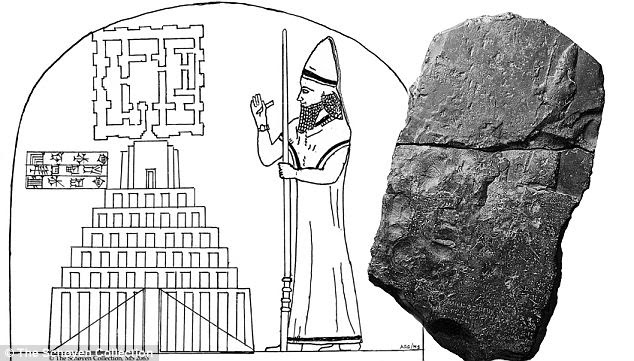
 Tower of Babel tablet: A reconstruction of the tablet, right, showing what the images would have originally looked like before they faded

 
by
 
Damien F. Mackey


“… there is no known relief depiction of Shalmaneser V …”.


Such is the case according to the article, "Shalmaneser V and Sargon II", at: http://emp.byui.edu/SATTERFIELDB/Rel302/Shalmaneser%20V%20and%20Sargon%20II.htm
.... The revolt of Israel against Assyria during the days of King Hoshea, last king of Israel, brought on a siege by the Assyrians (1 Kings 17). The siege was led by Shalmaneser V, King of Assyria (there is no known relief depiction of Shalmaneser V). During the siege, he died. Sargon II replaced Shalmanezer V as King of Assyria, who finished the siege and sacked Samaria.
 
Whilst that may be surprising in itself, the fact is – I believe - that Shalmaneser (so-called V) was the same person as Tiglath-pileser (known as III) of whom there are plenty of depictions.
 
 
And the lack of apparent portraits of Nebuchednezzar II was part of Dr. I. Velikovsky’s reason for (rightly) seeking to find an alter ego for the Great King (though wrongly, I think, equating him with the Hittite emperor, Hattusilis). Velikovsky wrote in Ramses II and His Time, p. 184: “At Wadi Brissa in Lebanon, Nebuchadnezzar twice had his picture cut in rock; these are supposedly the only known portraits of this king”.

Thursday, May 23, 2019

A Description of the Building of Sargon II’s City in the Book of Judith. Part Two


Part Two:

Were northern Israelite captives involved?


“The city of Halah, or Halahhu, in which Israelites were resettled was therefore located

just outside Sargon’s new capital city complex. Amazingly, in spite of this knowledge, apparently no one -- historian, scholar, or archaeologist -- has ever examined

this Halahhu city mound area. There seems to be no effort to trace lost Israel!”
 

Jory Steven Brooks


The only preliminary comment that I (Damien Mackey) would need to make regarding this interesting piece by Jory Steven Brooks:

http://www.hope-of-israel.org.nz/captiveisrael.html is that I may not necessarily accept the precise BC dates given therein.


The Book 2 Kings ch.17 v.6 reveals that one of the places to which Israel was transplanted was called, "Halah." Little has been written about this in Christian literature, and some scholars plead ignorance as to the correct location of this place of exile. However, the Anchor Bible Dictionary (III. 25) tells us that this word matches letter for letter with the Assyrian district of "Halahhu," except for the doubling of the last "h" and the addition of the characteristic Assyrian "u" case ending. The latter is not unusual, because the Biblical Haran (Genesis 11:32, 12:4-5, 28:10& 29:4) appears in Assyrian as "Haranu", and Ur, the birthplace of Abraham (Genesis 11:28 and 31, 15:7 and Nehemiah 9:7), is written as Uru.


This district of Halahhu was located north-east of the city of Nineveh in northern Assyria. A map shown in the Rand-McNally Bible Atlas (1956) indicates that Halahhu covered all of the area from Nineveh to the Zagros Mountains to the north and north-east (p. 244-5). In the midst of this district, King Sargon II purchased land along the Khosr River from the inhabitants of the small non-Assyrian town of Maganuba to build a new capital city. This new city was named Dur-Sharrukin, the Fortress of Sargon; it is better known today as Khorsabad after the modern small village of that name built on part of the ruins.


Halahhu was also the name of a city as well as a district. The Rand-McNally Bible Atlas (p. 297-8), informs us,


"Halah lay northeast of Nineveh, which city at a slightly later day had a gate named the 'gate of the land of Halah' [Halahhu]. Since there is reason to believe that the city lay between Nineveh and Sargon’s new capital [Khorsabad], the large mound of Tell Abassiyeh has been nominated for it. ….."


The city of Halah, or Halahhu, in which Israelites were resettled was therefore located just outside Sargon’s new capital city complex. Amazingly, in spite of this knowledge, apparently no one -- historian, scholar, or archaeologist -- has ever examined this Halahhu city mound area. There seems to be no effort to trace lost Israel! Is it perhaps because of the popular myth in books and journals that no Israelites were ever exiled or lost?


The reasons why Sargon moved the capital of Assyria from Nimrud to the new city of Dur-Sharrukin has been a fertile subject for speculation among scholars. Historians believe that his predecessor, Shalmaneser V, was murdered in Palestine during the siege of Samaria. The exact date of Shalmaneser’s death is unknown, but it may have been in 721 BC, because Sargon claimed to be the conqueror of the capital of Israel. If Sargon was in some way involved in the conspiracy that enabled him to seize power (an obvious supposition), he may have disdained ruling in the palace of his predecessor. Another possibility is that Sargon wished to expand the borders of Assyria northward into the sparsely inhabited Zagros Mountains, its foothills and valleys, to strengthen his northern border.


Whatever the reasons, a marvellous palace complex came into being almost a mile square, twelve miles north-east of Nineveh along the Khosr River. It was a massive building project. Assyrian scholar William R. Gallagher tells us that in Assyrian terms, Dur-Sharrukin was 2,935 dunams in size, compared to the city of Jerusalem at only 600 dunams (Sennacherib’s Campaign, p. 263). Yet this accomplishment was in spite of the fact that Assyria had a massive labour shortage:


"At least two letters to Sargon indicate a shortage of manpower. In one letter the sender complained that the magnates had not replaced his dead and invalid soldiers. These amounted to at least 1,200 men. The second letter, probably from Taklak-ana-Bel, governor of Nasibina, reports a scarcity of troops" (ibid., p.266).


This labour shortage was partly due to the massive capital building project, but also because of a deadly epidemic resembling the bubonic plague that later raged across Europe in the fourteenth century AD. The Akkadian word for it was "mutanu", the plural of "mutu," meaning death. This epidemic struck not just once, but several times (802, 765, 759, and 707 BC) with deadly effect. Historical records indicate that this plague had so decimated the Assyrian army by 706 BC that they were unable to engage in any military missions at all that year (ibid., p. 267).


The Oriental Institute of the University of Chicago carried out an archaeological excavation at the site of Dur-Sharrukin during the years 1930-33, and published an account of their discoveries in a volume written by Henri Frankfort which says the following:


"We know that Sargon used a considerable amount of forced labor in the building of his capital -- captives and colonists from other parts of the empire" (p. 89).


Assyrian scholar Gallagher adds:


"Sargon II’s cumbersome building projects at Dur-Sharrukin had placed a great strain on the empire...Much of the forced labor on Sargon‘s new city was done by prisoners of war. The conditions shown on Sennacherib’s palace wall reliefs for the transport of his bull colossi were undoubtedly the same as in Sargon‘s time. They show forced laborers under great exertion, some clearly exhausted, being driven by taskmasters with sticks" (ibid., p. 265).


Mackey’s comment re: “The conditions shown on Sennacherib’s palace wall reliefs for the transport of his bull colossi were undoubtedly the same as in Sargon’s time”.

Sargon II was Sennacherib:


Assyrian King Sargon II, Otherwise Known As Sennacherib


Jory Steven Brooks continues:


A text inscribed upon a carved stone bull at Dur-Sharrukin states,


"He [Sargon] swept away Samaria, and the whole house of Omri" (Records Of The Past, XI:18).


The "House of Omri" was the Assyrian designation for Israel, and was spoken with a guttural applied to the first vowel, so that it was pronounced "Khumri." Following Sargon’s terse statement was a notice of the building of the new Assyrian capital city. Construction of Dur-Sharrukin began in 717 BC, only four years after the fall of Samaria, and took over ten years, with ceremonies marking its completion in 706 BC.


Although there is no record of the exact date that the Assyrians marched the Israelite residents of Samaria eastward to Halah(hu), it is probable that Sargon knew from the beginning of his rule (or even before he became king) that he would build his palace in that location. Did he send the Israelites there in order to help build his new city, the capital of Assyria? If not, why were they there during these years of construction? Although proof does not exist at present, the correlation of location and dates, coupled with the great need for labourers, makes it highly probable that YEHOVAH’s people were involved.


And how appropriate was the symbolism resulting from this circumstance! Israel was called to build the Kingdom of YEHOVAH God on earth, but refused. They turned their hearts to false gods and worshipped the work of men’s hands. Because of this, YEHOVAH used the Assyrians, perhaps the foremost pagan idolaters, to punish his people. Those who had been offered the highest honour of building YEHOVAH’s earthly dominion instead were consigned the deepest dishonour of building the earthly dominion of the enemies of YEHOVAH God.


Many of the wall reliefs, stone idols, and other important finds from Dur-Sharrukin are now on display at the Oriental Institute in Chicago. Included is a massive stone winged bull termed in Assyrian, "Lamassu," that formerly stood at the doorway to King Sargon’s throne room. The carving and moving of several of these monstrous stone monuments was undoubtedly one of the most amazing feats of human labour. They were composite figures, with a human face, a body that was part bull, part lion, and wings of a bird. The king was thus symbolically empowered with the formidable qualities of speed, power, and intelligence.


Wednesday, May 22, 2019

King Nabonidus like an Assyrian monarch


Ashurbanipal 

 by
 
Damien F. Mackey


Nabonidus is an Assyrian king.
He adopts Assyrian titulature and boasts of having
the Assyrian kings as his "royal ancestors".


This is what I wrote some years ago now to Johnny Zwick, sysop of the California Institute for Ancient Studies (then www.specialtyinterests.net/), regarding my projected realignment of late Judah with neo Assyro-Babylonia:
 
My connecting of Hezekiah of Judah with Josiah went down like a lead balloon amongst the few to whom I sent it. (See Pope’s valuable effort at: http://www.domainofman.com/book/chart-37.html)
 
[Comment: I have since re-done this properly in my article:

 
'Taking aim on' king Amon - such a wicked king of Judah


So here is the next phase. I would not actually call it a bombshell.
More like a Third World War.
Nabonidus is an Assyrian king. He adopts Assyrian titulature and boasts of having the Assyrian kings as his "royal ancestors". There is nothing particularly strange about his supposed long stay in Teima in Arabia. This was a typical campaign region adopted by the neo-Assyrian kings. There is nothing particularly remarkable about his desire to restore the Ehulhul temple of Sin in Harran.
Ashurbanipal did that.
 
Nabonidus is said to have had two major goals, to restore that Sin temple and to establish the empire of Babylon along the lines of the neo-Assyrians. Once again, Ashurbanipal is particularly mentioned as being his inspiration.
 
Nabonidus was not singular in not taking the hand of Bel in Babylon for many years, due to what he calls the impiety of the Babylonians. Ashurbanipal (and now you will notice that he keeps turning up) could not shake the hand of Bel after his brother Shamash-shum-ukin had revolted against him, barring Babylon, Borsippa, etc. to him. He tells us this explicitly.
 
Nabonidus is not singular either in not expecting to become king. Ashurbanipal had felt the same.
So, basically Nabonidus is Ashurbanipal during his early reign. They share many Babylonian building works and restorations, too.
 
Now, if Nabonidus is Ashurbanipal (and I am now pretty much convinced that he must be), then Ashurbanipal of 41-43 years of reign (figures vary) can only be Nebuchednezzar II the Great of an established 43 years of reign.
Nebuchednezzar is the Babylonian face, while Ashurbanipal is the Assyrian face.
The great Nebuchednezzar has left only 4 known depictions of himself, we are told. Ridiculous! Add to this paltry number all of the depictions of Ashurbanipal.
 
The last 35 years of Nebuchednezzar are hardly known, they say. Add Ashurbanipal (whose lack also in places is supplemented in turn by Nebuchednezzar/Nabonidus).
 
It is doubted whether Nebuchednezzar conquered Egypt as according to the Bible. Just add Ashurbanipal who certainly did conquer Egypt.
 
The many queries about whether an inscription belongs to Nebuchednezzar or Nabonidus now dissolves.
 
It was Nabonidus, not Nebuchednezzar, they say, who built the famous palace in Babylon.
Nabonidus's well known madness (perhaps the Teima phase) is Nebuchednezzar's madness.
Nabonidus calls Sin "the God of gods" (ilani sa ilani), the exact phrase used by Nebuchednezzar in Daniel 2:47 of Daniel's God ("the God of gods").
 
Looking for a fiery furnace? Well, Ashurbanipal has one. His brother dies in it.
“Saulmagina my rebellious brother, who made war with me, they threw into a burning fiery furnace, and destroyed his life” (Caiger, p. 176).
….